
Once upon a time, there was a shopper who stopped at a supermarket to buy a bottle of water.
She thought it would take a minute.
But, the shelf had grown since her last visit.
There were bottles for athletes. Bottles from glaciers. Bottles with electrolytes, minerals, and promises of a better future.
Every bottle wanted to be chosen.
By the time the shopper reached for one, she wasn’t thirsty anymore.
She was tired.
She was me.
This story is not about indecision. It’s about how hard it has become to simply decide.
Long before supermarket aisles became endless scrolls of labels and reviews, economist and cognitive scientist Herbert Simon observed that people rarely searched for the best option. Instead, they searched for one that was good enough.
He called it satisficing.
It wasn’t laziness. It was efficiency.
Find something that meets your needs, make the choice, and move on.
But somewhere between the rise of review culture and the arrival of algorithmically perfect ads, “good enough” started to feel irresponsible. Every choice came with the nagging feeling that a better one was still out there.
And the feeling wasn’t imagined.
Psychologist Barry Schwartz argued that, beyond a point, more choice doesn’t make us happier. It makes us more anxious about the choices we didn’t make.
Did I read enough?
Did I compare enough?
Did I miss a better one?
I recognised the script instantly, because I’d run it before.
On every food delivery app, reading the same menu for the fourth time, still deciding between the two dishes I always end up choosing, as if reading it for longer might show me something the last three didn’t.
At home, scrolling a streaming platform for twenty minutes before. Dinner getting cold, only to land on something I’d already watched multiple times before.
The choosing, somehow, kept taking longer than the enjoying.
Daniel Kahneman’s research helps explain why.
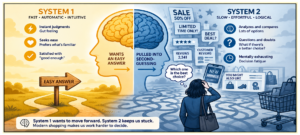
Modern shopping has become remarkably good at keeping us in the second. The result isn’t a better-informed shopper.
It’s a permanently unsettled one.
The longer the shopper stood in the aisle, the more there was to see. More labels. More comparisons. More recommendations. More reasons to wait.
For the businesses behind those shelves, attention is valuable. Every extra minute spent comparing is another chance to persuade, retarget or reassure. The goal isn’t always to help someone decide. Often, it’s to keep the decision alive.
It’s no surprise, then, that trust in advertising has steadily declined. People aren’t imagining the feeling that they’re being kept in the loop rather than helped out of it.
The irony is that we discovered this long before online shopping existed.
Let’s take a moment, and remember the corner shop from our home. It has displayed the same three loaves of bread for years now. Grab one on your way back from work, done.
The new supermarket across from the office has thirty. A dozen versions of the same white loaf. You stand there reading labels, and you still walk out with the brand you always buy. Sometimes you walk out with nothing.
More choices invited curiosity. It didn’t inspire commitment.
Perhaps that’s the lesson brands need today.
Respecting the shopper’s mind isn’t about adding more reasons to buy. It’s about removing reasons to hesitate.
Fewer, clearer choices. Honest defaults.
Copy that says, “This is for you,” instead of, “Here’s everything you could possibly have.”